
Achieving Micro-Precision Deburring through Electropolishing
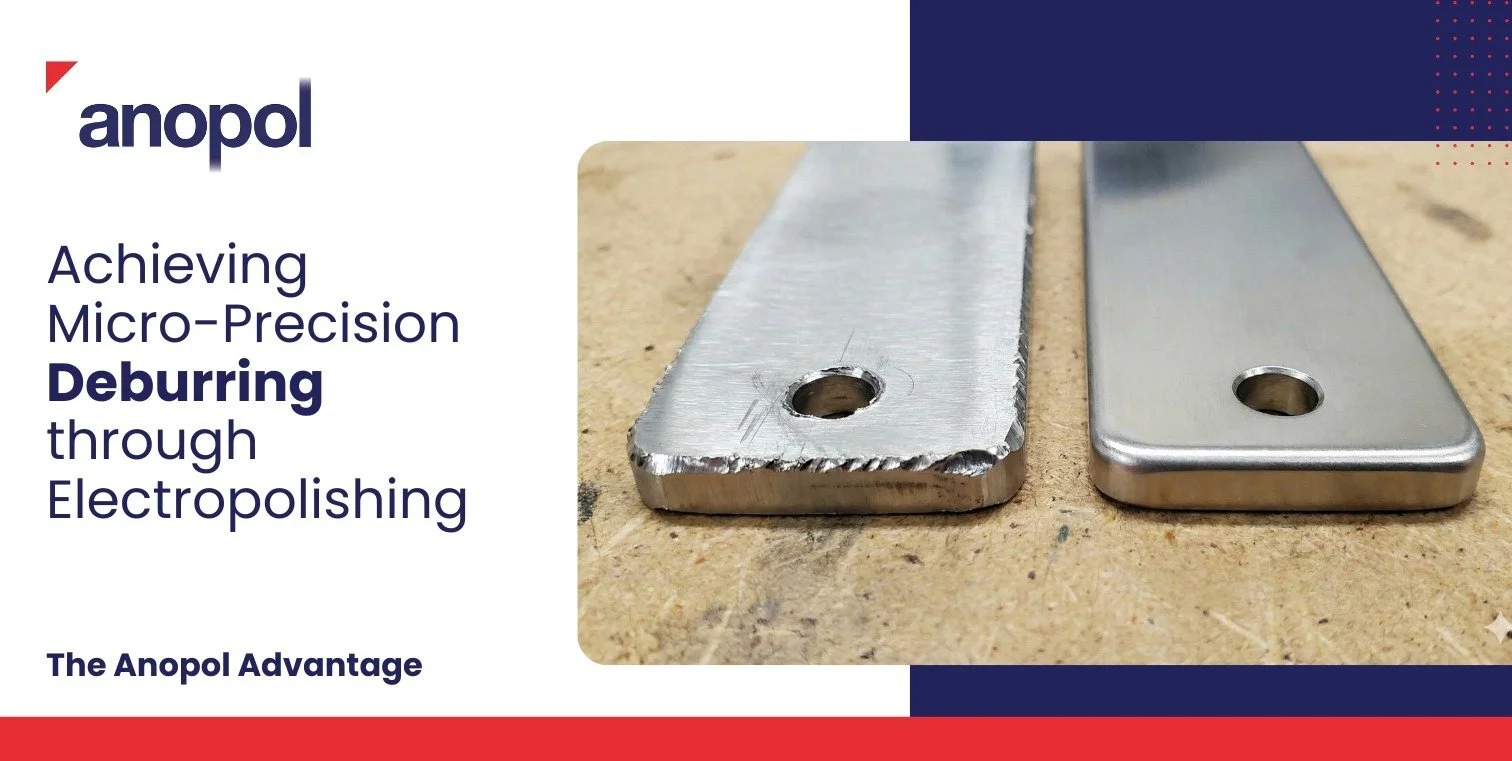
In high-stakes manufacturing, particularly within the aerospace, medical, and semiconductor sectors, meeting dimensional tolerances is only half the challenge. The critical final hurdle is often microscopic: the burr.
These unwelcome remnants of the machining process, sharp edges, minute raised fragments, and micro-protrusions, are inevitable byproducts of drilling, stamping, milling, or laser cutting. While often invisible to the naked eye, their presence can disastrously compromise the safety, performance, and longevity of a critical component.
At Anopol, the UK’s leader in electropolishing and surface treatment, we view deburring not just as a cleaning step, but as a vital precision engineering process.
The Persistent Challenge of Burrs
Burrs are an inherent consequence of metalworking. Variables such as material hardness, tool wear, and complex part geometries all contribute to their formation.
If left unaddressed, these microscopic flaws create macroscopic problems. A single burr can interfere with intricate assembly, damage mating components, create safety hazards for handlers, or serve as a trap for contaminants, accelerating corrosion and leading to premature part failure. In industries where failure is not an option, effective, repeatable deburring is imperative.
The Limitations of Mechanical Deburring
Traditional approaches to burr removal often fall short when applied to modern, high-precision components.
Mechanical methods—such as abrasive blasting, vibratory tumbling, or manual hand-finishing—rely on friction and impact. These techniques introduce significant risks:
Inconsistency: Manual deburring varies from operator to operator, making quality control difficult across large batches.
Distortion: Aggressive mechanical processes can bend fragile parts or alter critical dimensions on components with tight tolerances.
Inaccessibility: Mechanical tools cannot navigate complex internal passages, blind holes, or intricate micro-features, leaving hidden burrs behind.
For complex geometries, mechanical deburring is often a blunt instrument trying to solve a precision problem.
The Anopol Solution: Precision Electrochemical Deburring
Electropolishing offers a fundamentally different approach to burr removal. It is a non-contact, electrochemical process that rectifies the surface on a microscopic level.
By submerging parts in a specially formulated electrolyte and applying a controlled electrical current, the process selectively targets high points on the metal surface. Because electrical current density is greatest at sharp protrusions, burrs are preferentially dissolved away first.
Unlike mechanical methods that tear or abrade material, electropolishing removes metal ion by ion. This ensures:
Uniformity: The process works simultaneously across the entire surface of the part.
Zero Stress: As a non-impact process, there is no risk of thermal stress or mechanical distortion to delicate features.
Total Accessibility: The electrolyte flows wherever the liquid can reach, effectively deburring internal threads, complex channels, and hard-to-reach interior surfaces that mechanical tools cannot touch.
Crucially, electropolishing is a multi-functional process. While removing burrs, it simultaneously enhances corrosion resistance, reduces surface friction, and delivers an ultraclean, passivated finish.
Ideal Applications for Electropolishing
As the UK leaders in this field, Anopol regularly utilizes electropolishing as the primary deburring step for components requiring the highest degree of integrity. It is the definitive solution for:
Components with fragile or micro-scale features.
Complex internal geometries and blind holes.
Parts requiring exceptionally tight tolerances.
Stainless steel and high-alloy materials used in corrosive environments.
Applications demanding critical cleanliness, such as medical implants or semiconductor equipment.
Scalable Consistency
The true power of the Anopol approach lies in repeatability. Our highly controlled, chemistry-driven processes ensure that the deburring result on the first part is identical to the result on the ten-thousandth part. This level of consistency is essential for OEMs requiring predictable quality in high-volume production runs.
Move beyond the limitations of traditional finishing. Contact the experts at Anopol today to discuss how our electropolishing services can resolve your most challenging deburring requirements.