
Pickling, Passivation, Electropolishing: Which Treatment Does Your Project Actually Need?
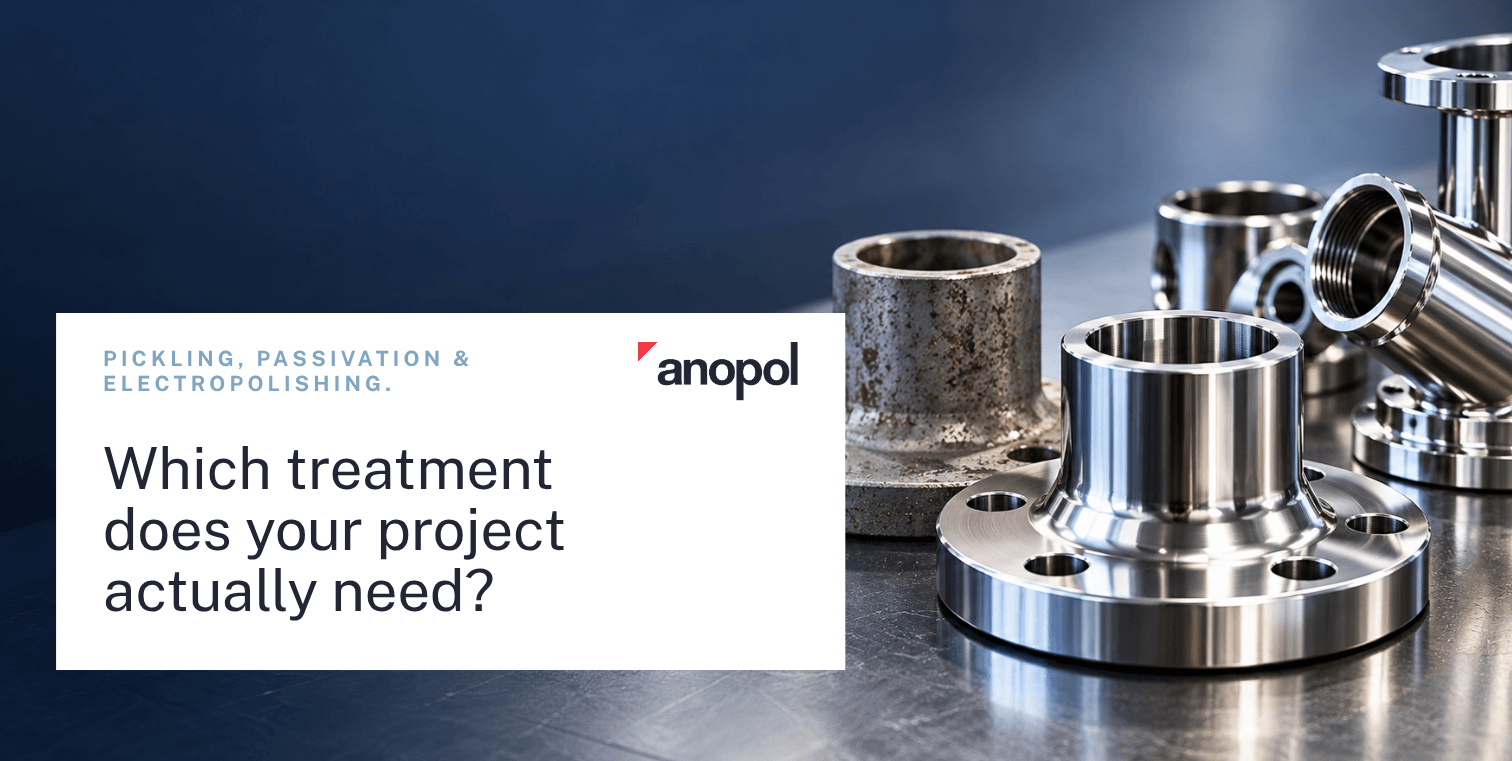
Three treatments, three different jobs
Pickling, passivation and electropolishing all use chemistry to improve stainless steel, so they are easy to confuse. They are often specified interchangeably on drawings and purchase orders. But each one solves a different problem, and choosing the wrong one can mean paying for a finish you don't need, or missing the protection you do.
Since 1967, our Birmingham team has helped engineers, fabricators and buyers make this call. This guide explains what each treatment does, where it fits, and how to decide which one your parts actually need.
Pickling: the heavy-duty clean-up
Pickling removes the damage that fabrication leaves behind. Welding, hot forming and heat treatment create scale, heat tint and discoloured oxide layers. Beneath them sits a chromium-depleted zone that is far more prone to corrosion.
An acid treatment dissolves these layers and a thin skin of the metal underneath, exposing clean, corrosion-resistant stainless steel. The result is usually a uniform matt or satin finish rather than a bright one.
Choose pickling when:
Parts have been welded and show heat tint or weld scale
Components have been hot formed or heat treated
Corrosion resistance matters more than appearance
You need to restore fabricated assemblies such as tanks, pipework, frames and vessels
Passivation: invisible protection
Passivation strengthens stainless steel's natural defence without changing how it looks. Stainless steel resists corrosion because of a thin chromium oxide film on its surface. Machining, cutting and handling can leave free iron and contaminants that break that film and cause rust spots.
Passivation uses a milder acid to remove those contaminants and help the protective layer re-form evenly. It does not remove scale or heat tint, and it removes little or no base metal, so dimensions and appearance stay the same.
Choose passivation when:
Parts are machined, clean and free of weld discolouration
Tight tolerances mean no material can be removed
The existing finish already looks right
Your customer or specification calls for a recognised passivation standard
Electropolishing: the premium finish
Electropolishing goes furthest, delivering a smooth, bright surface with maximum corrosion resistance. The part is immersed in an electrolyte and an electrical current removes a precisely controlled layer of metal. Microscopic peaks dissolve faster than valleys, so the surface is levelled at a level no mechanical polish can reach.
The process also deburrs, removes embedded contaminants and leaves a chromium-rich passive layer. That makes surfaces easier to clean and harder for bacteria, product residue or particles to cling to.
Choose electropolishing when:
Hygiene is critical, as in food, pharmaceutical and medical applications
Surfaces must be ultra-clean, as in semiconductor and cleanroom equipment
Parts need a bright, premium appearance
Components have fine burrs or complex shapes that are hard to finish by hand
At a glance
| Pickling | Passivation | Electropolishing | |
|---|---|---|---|
| Main purpose | Remove scale and heat tint | Restore the passive layer | Smooth, clean and protect |
| Removes weld discolouration | Yes | No | Yes |
| Removes base metal | Thin layer | Little or none | Controlled layer |
| Finish | Matt or satin | Unchanged | Smooth and bright |
| Improves cleanability | Moderately | Slightly | Significantly |
| Typical uses | Fabrications, tanks, pipework | Machined and precision parts | Food, pharma, medical, semiconductor |
Four questions to find your answer
Has the part been welded, hot formed or heat treated? If you can see heat tint, scale or discolouration, passivation alone won't fix it. Start with pickling or electropolishing.
Does the surface need to be hygienic or ultra-clean? If product, bacteria or particles must not build up, electropolishing is the strongest choice.
How tight are your tolerances? If no material can be removed, passivation is usually the safest route. Electropolishing removes a controlled amount that can be planned into the design.
How should it look? Matt and functional points to pickling. Unchanged points to passivation. Bright and premium points to electropolishing.
Still unsure? Your specification, end use and material grade all affect the answer, and that is exactly the conversation we have with customers every day.
Sometimes the answer is more than one
The treatments are not always either/or. A welded food-processing vessel might be pickled to remove heat tint, then electropolished for a hygienic internal finish. A machined component might be passivated after final assembly to deal with contamination from handling.
Planning the sequence early, at design or quotation stage, avoids rework and keeps lead times predictable.
Talk to the people who do this every day
Anopol has been finishing stainless steel in Birmingham since 1967, with pickling, passivation and electropolishing all under one roof, including PFAS-free chemistry. Send us a drawing, a photo or a sample part, and we'll recommend the right treatment for your application, tolerances and budget. Contact us today to discuss your next project.