
Why Electropolishing is the Gold Standard for Cleanroom Integrity
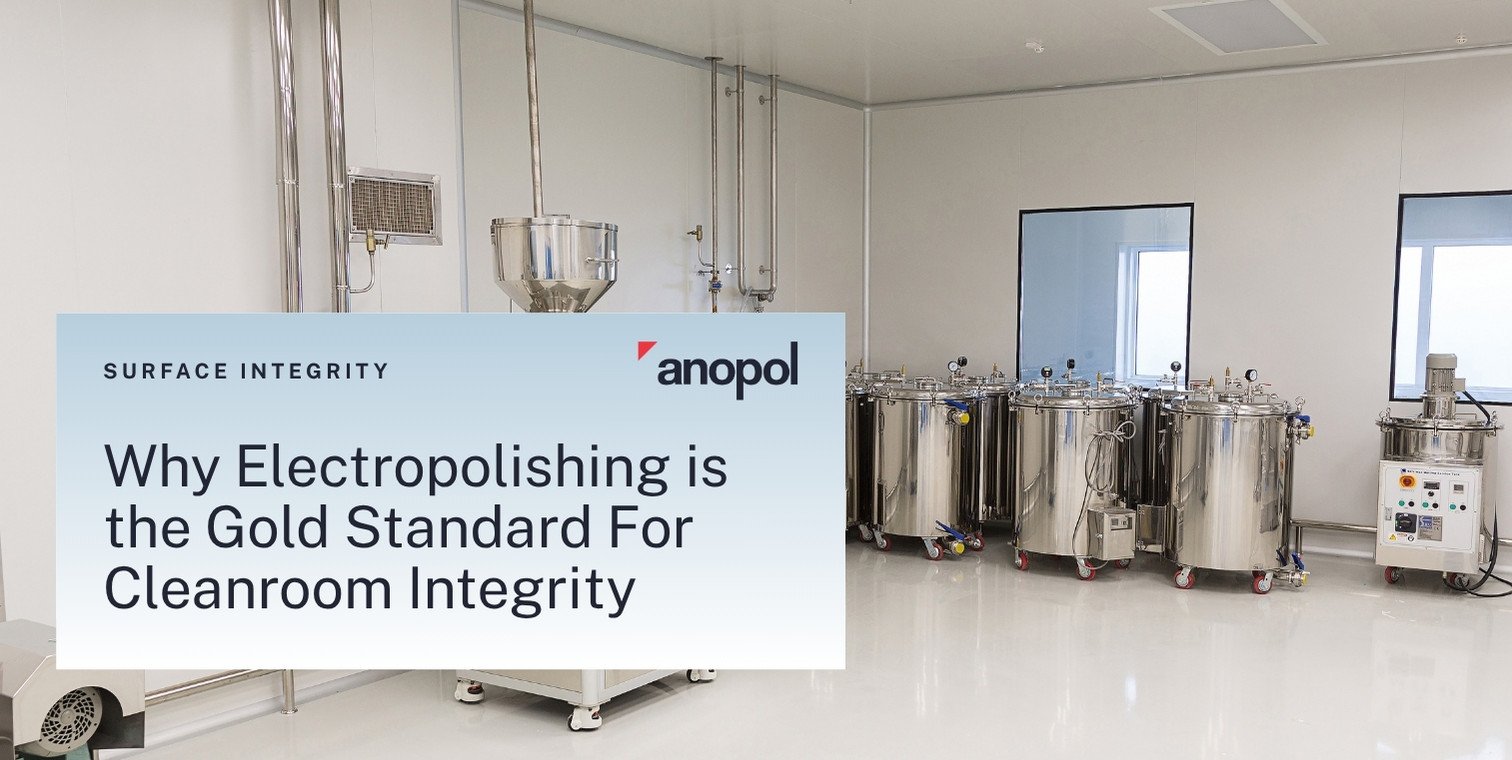
In a controlled environment, “clean” is not an aesthetic, it is a measurable technical requirement. Whether you are operating a Grade A pharmaceutical suite or a high-end semiconductor fab, the surface integrity of your stainless steel equipment is your first line of defence against contamination.
While mechanical polishing may provide a shiny finish, it often masks a microscopic landscape of jagged peaks and valleys. For the cleanroom sector, this is a hidden liability. Here is why Anopol’s electropolishing process is the essential choice for cleanroom-ready components.
1. Eliminating the Microscopic “Hideouts”
Mechanical polishing uses abrasives that can smear the surface of the metal, trapping compounds, oils, and particulates beneath a “Beilby layer” of distorted metal. Under a microscope, these surfaces look like a plowed field—full of crevices where bacteria (bioburden) can colonise and resist standard CIP (Clean-in-Place) protocols.
The Anopol Advantage: Electropolishing is an electrochemical removal process. It doesn’t smear; it dissolves the “peaks,” leaving a featureless, microscopically smooth surface. This significantly reduces the Relative Surface Area (RSA), making it nearly impossible for particulates to adhere.
2. Maximum Corrosion Resistance via Passivation
Cleanrooms are subjected to aggressive sterilisation cycles, often involving vaporised hydrogen peroxide (VHP) or caustic cleaning agents. Standard 316L stainless steel can still suffer from “tea-staining” or pitting if the passive layer is compromised.
Electropolishing goes beyond simple passivation. By selectively removing iron from the surface, the process leaves a surface enriched with Chromium and Nickel. This creates a robust, transparent Chromium-Oxide layer that:
Exceeds the requirements of ASTM B912.
Resists oxidation in high-humidity environments.
Prevents the leaching of metallic ions into sensitive products.
3. Non-Particulating Surfaces
In semiconductor and vacuum applications, outgassing and particulate shedding are project-killers. Mechanically finished steel can “shed” microscopic metal flakes over time due to the stresses induced during the grinding process.
Because electropolishing is a “stress-free” process, it removes the burrs and microscopic slivers that lead to shedding. The result is a non-particulating finish that maintains the air quality class of your environment, from ISO 8 down to ISO 1.
Summary of Benefits for Cleanroom Assets.
| Feature | Mechanical Polish | Anopol Electropolish |
|---|---|---|
| Surface Morphology | Jagged / torn surface layers | Smooth, featureless finish |
| Cleanability | Moderate — micro-crevices trap bacteria | Superior — easy wipe and sterilisation |
| Corrosion Resistance | Standard stainless properties | Enhanced chromium-rich passive layer |
| Contaminants | Abrasives and iron may become embedded | Chemically pure ultra-clean surface |
Engineering the Future of Clean
As the UK’s leader in electropolishing, Anopol understands that in a cleanroom, the surface is the product. From stainless steel furniture and trolleys to complex valve manifolds and vessel internals, we provide the finish that ensures your facility remains compliant, sterile, and efficient.
Don’t leave your contamination control to chance. Specify Anopol Electropolishing for your next cleanroom project.