
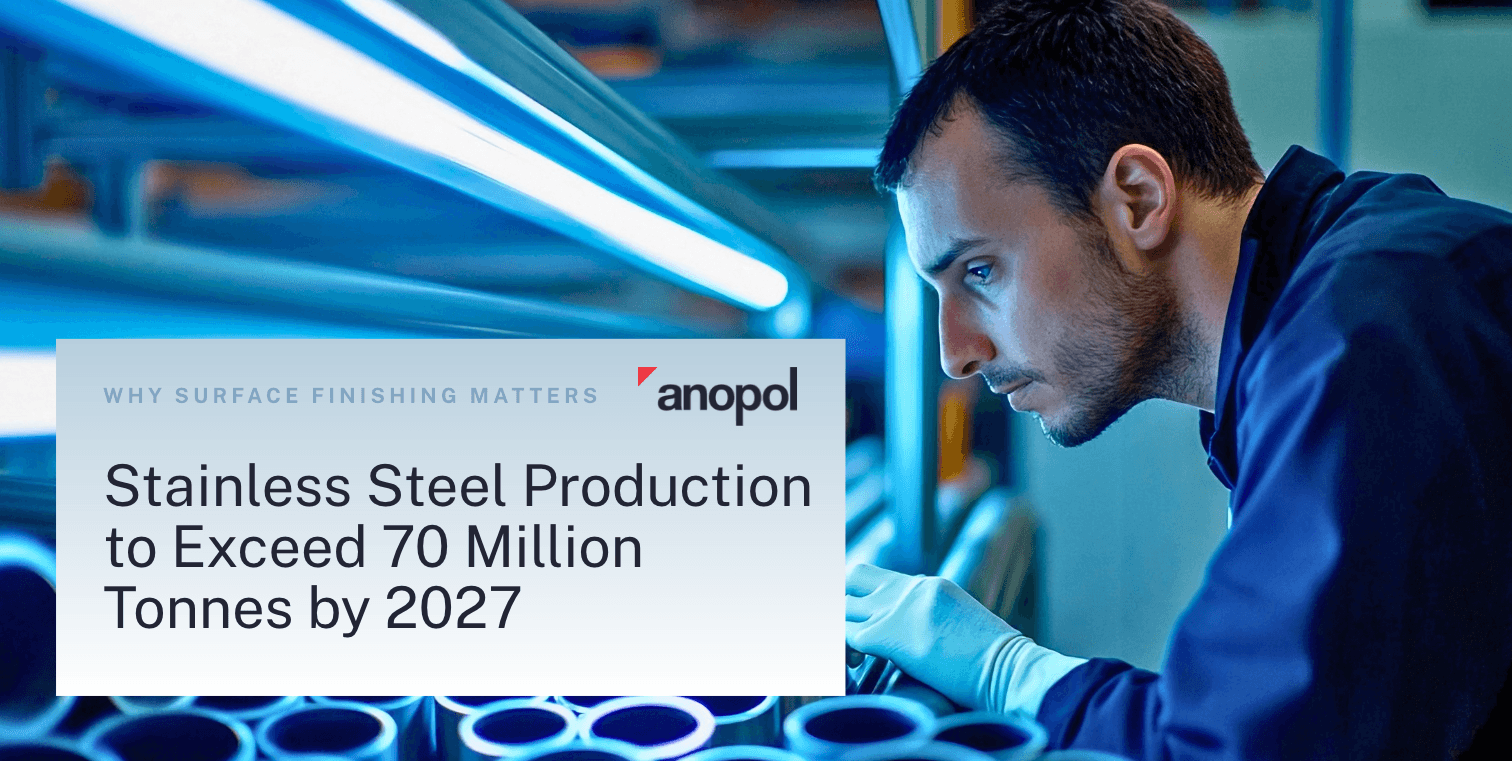
As global stainless steel production continues to grow, manufacturers face increasing pressure to deliver corrosion resistance, cleanliness and long-term performance. Here's why the finishing process deserves greater attention.
1. Introduction
The global stainless steel industry is heading towards a significant milestone.
According to new research presented at the Bureau of International Recycling (BIR) World Convention in Málaga in October 2026, global stainless steel production is forecast to exceed 70 million tonnes in 2027.
The figures, presented by Dr Gerhard Pariser of Steel & Metals Market Research, suggest the global stainless steel market is growing by approximately 5% annually, with demand forecast to increase by 3.8% in 2026 and 4.4% in 2027.
It's a remarkable outlook for a material already central to modern manufacturing, infrastructure and engineering.
But while much of the industry's attention is focused on production volumes, international trade and raw material availability, there is another important consideration for manufacturers.
What happens to stainless steel after it has been fabricated?
At Anopol, we believe the answer deserves just as much attention as the material itself.
A growing global industry
New forecasts highlight the scale of stainless steel production and demand.
Forecast global stainless steel production in 2027
Approximate global stainless steel market growth rate
Forecast increase in global stainless steel demand in 2027
3. A growing market brings new challenges
The projected growth is encouraging, but the picture is not without complications.
The BIR presentation highlighted increasing global production capacity, geopolitical uncertainty and changing trade policies as major challenges facing the stainless steel industry.
Production has also shifted considerably over the past 25 years. China and Chinese-controlled facilities in Indonesia now account for approximately 72% of global stainless steel production, compared with just 3% in 2000. Europe's share has fallen from around 40% to 9%.
Meanwhile, planned production capacity expansions in China, Indonesia and India could add approximately 15 million tonnes by 2031, potentially exceeding the additional demand expected within those markets.
For UK manufacturers and engineering businesses, these developments reinforce the importance of quality, consistency and adding value throughout the manufacturing process.
While material costs, supply chains and international competition remain important, the performance and longevity of finished components are equally significant.
This is where stainless steel surface finishing plays an essential role.
4. Why stainless steel surface finishing matters
Stainless steel is widely specified because of its corrosion resistance, durability and suitability for demanding environments.
However, its performance depends on more than simply selecting the correct grade.
During fabrication, processes such as welding, cutting, grinding and handling can affect the condition of the metal's surface.
Heat tint, embedded contamination, free iron deposits and surface irregularities may all compromise the finish and, in some circumstances, reduce corrosion resistance.
A component may be manufactured from high-quality stainless steel, but that does not automatically mean its surface is in the optimum condition for service.
Appropriate surface treatment can help address these issues.
For manufacturers supplying sectors such as food and beverage, pharmaceutical processing, chemical engineering and precision manufacturing, this can be particularly important.
5. Three important stainless steel surface treatments
At Anopol, three of the most established treatments are electropolishing, pickling and passivation. Although they are often discussed together, each serves a different purpose.
Electropolishing - improving surface finish and performance
Electropolishing is an electrochemical process that removes a controlled layer of material from the stainless steel surface.
It can reduce microscopic surface irregularities, improve cleanability, enhance appearance and help optimise corrosion resistance.
The process is particularly valuable for components where surface condition, hygiene or precision are important.
Pickling - removing weld scale and heat tint
Pickling uses chemical treatment to remove surface oxides, heat tint and certain contaminants arising from manufacturing and welding.
It is often an important stage in restoring the corrosion-resistant properties of fabricated stainless steel, particularly around welded areas.
Passivation - supporting corrosion resistance
Passivation is a chemical treatment designed to remove free iron and certain surface contaminants, helping the stainless steel develop or maintain its protective passive oxide layer.
It is widely used where corrosion resistance and surface cleanliness are important.
The correct treatment depends on the stainless steel grade, fabrication history, component geometry and intended operating environment.
Which stainless steel treatment is right for your application?
Different manufacturing challenges require different surface finishing solutions.
Electropolishing
SURFACE FINISH
Removes a controlled surface layer to improve finish, cleanability and corrosion performance.
Hygienic equipment, precision components and complex stainless steel fabrications.
Pickling
OXIDE REMOVAL
Removes weld heat tint, scale and surface oxides following fabrication.
Welded pipework, tanks, vessels and industrial fabrications.
Passivation
CORROSION RESISTANCE
Removes free iron contamination and supports formation of the protective passive layer.
Stainless steel components requiring improved surface cleanliness and corrosion resistance.
Treatments may be used individually or in combination, depending on the material and specification.
7. Growing demand for stainless steel means greater attention to quality
As stainless steel production increases, manufacturers will continue to face pressure to balance cost, quality, delivery times and product performance.
For businesses manufacturing stainless steel components, the finishing process should not be treated as an afterthought.
It can influence how easily equipment is cleaned, how effectively surfaces resist corrosion and how components perform in their intended environment.
Consider a stainless steel vessel used in food production, for example.
The vessel may have been fabricated to an excellent standard, but weld heat tint, rough surfaces or contamination could still create problems if not properly addressed.
Similarly, stainless steel pipework used in chemical processing may require specific surface treatments to achieve the necessary condition before entering service.
Selecting the appropriate finishing process early in a project can help manufacturers avoid unnecessary rework and ensure that finished components meet the required specification.
Importantly, not every application requires electropolishing, and not every stainless steel component needs the same treatment.
Understanding the operating environment and technical requirements is essential.
8. Sustainability, durability and getting more from stainless steel
Another important consideration is the role of stainless steel in more resource-efficient manufacturing.
The BIR highlighted the importance of recycled materials to the industry's future, reporting that the average recycled content in stainless steel production is approximately 30% globally. Access to recycled material remains a significant issue for producers.
Stainless steel is valued for its potential to provide a long service life, but achieving that potential requires appropriate material selection, design, fabrication, finishing and maintenance.
Where surface treatment helps prevent avoidable corrosion or premature component replacement, it can contribute to a more durable finished product.
For manufacturers, the objective should be straightforward: produce components that perform as intended for as long as reasonably possible.
Surface finishing is one part of achieving that goal.
9. The opportunity for UK manufacturers
The forecast growth in global stainless steel production demonstrates the continued importance of this versatile material.
But for UK manufacturers competing in increasingly demanding markets, success is not simply about producing more.
It is about delivering quality, consistency and reliable performance.
Whether manufacturing stainless steel tanks, pipework, precision components or complex fabrications, the surface condition of the finished product can be critical.
Electropolishing, pickling and passivation each have a valuable role to play, provided they are selected and applied correctly.
At Anopol, our focus is on helping manufacturers understand those requirements and identify suitable surface treatment solutions for their applications.
As the global stainless steel industry moves towards its next major production milestone, the importance of what happens after fabrication should not be overlooked.
Because the quality of stainless steel doesn't end with the material. It extends to the finish.
10. Closing call to action
Need advice on stainless steel surface finishing?
Whether you're planning a new fabrication project, reviewing a surface treatment specification or looking to improve the finish of existing components, Anopol can help.
Our team provides specialist electropolishing, pickling and passivation services for stainless steel applications across a wide range of industries.
Contact Anopol to discuss your requirements and find the right treatment for your components.
Visit: www.anopol.com