
When Surface Roughness Becomes a Manufacturing Risk: Why Ra Alone Doesn't Tell the Whole Story
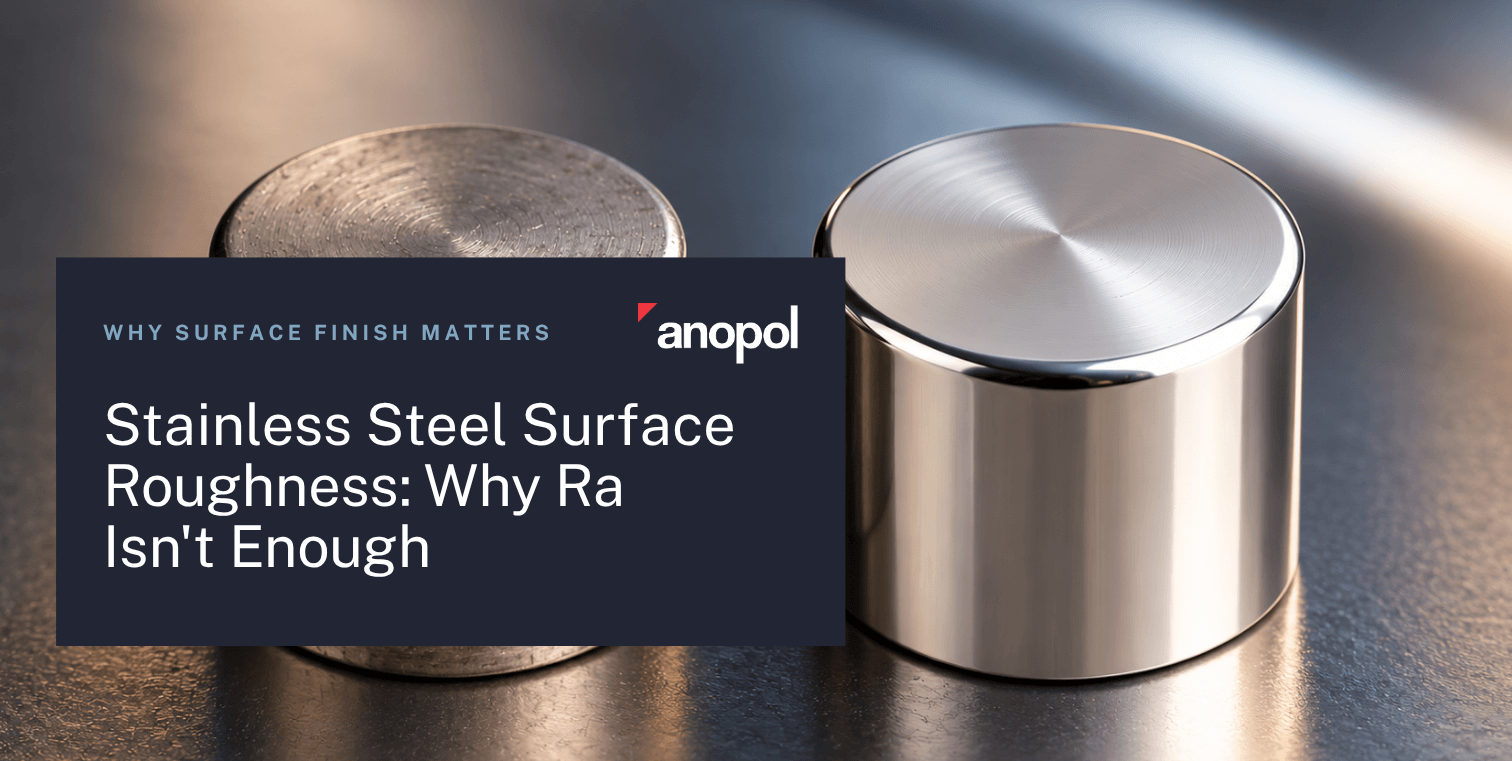
A smooth stainless steel surface is not necessarily a clean one. For manufacturers working in hygiene-critical, precision and corrosion-sensitive environments, understanding what lies beneath the surface finish can be just as important as the finish itself.
In industries where stainless steel components must perform reliably under demanding conditions, surface quality is more than a cosmetic consideration.
From pharmaceutical processing equipment and food production machinery to precision-engineered components, the condition of a stainless steel surface can influence cleanability, corrosion resistance, contamination risks and long-term performance.
Yet one of the most widely used measures of surface quality, the Ra value, tells only part of the story.
Two stainless steel components can have virtually identical surface roughness measurements while exhibiting significantly different microscopic characteristics.
Understanding this distinction is important when specifying surface finishing treatments, particularly where electropolishing, pickling and passivation are being considered.
What Does Ra Actually Measure?
Ra, or arithmetic mean roughness, is a measurement of the average absolute deviation of a surface profile from its mean line over a defined evaluation length.
Expressed in micrometres (µm), it provides a useful numerical indication of surface roughness.
For example, a component with an Ra value of 0.4 µm generally has a lower measured average roughness than one with an Ra value of 0.8 µm, assuming comparable measurement conditions.
However, Ra does not provide a complete description of the surface.
It does not, by itself, reveal whether the surface contains embedded contamination, microscopic folds, deep isolated scratches, damaged material or other features that may affect performance.
This creates an important distinction between measured roughness and functional surface quality.
A surface may satisfy a specified Ra requirement while retaining characteristics that make it more difficult to clean or more susceptible to localised corrosion.
Why Two Surfaces with the Same Ra Can Perform Differently
Consider two stainless steel components, both measured at 0.4 µm Ra.
One has been mechanically polished using abrasives. The other has undergone suitable preparation followed by electropolishing.
Although their average roughness measurements may be similar, their microscopic surface characteristics can differ.
Mechanical polishing removes material through abrasion. Depending on the process, it can leave directional scratches, smeared metal, embedded abrasive particles or surface irregularities.
Electropolishing works differently.
It is an electrochemical process that removes a controlled layer of metal from the surface, preferentially dissolving microscopic high points under suitable processing conditions.
This can reduce fine surface irregularities and remove contamination associated with previous manufacturing operations.
Consequently, two surfaces with similar Ra values may exhibit different cleanability and corrosion-related characteristics.
The European Hygienic Engineering & Design Group (EHEDG) recognises this distinction in its hygienic equipment design guidance, noting that surface topography and the method of finishing can influence cleanability.
The lesson for manufacturers is straightforward: the method used to achieve a surface finish can matter as much as the numerical roughness value.
Why Surface Condition Matters in Hygienic Manufacturing
For food, beverage and pharmaceutical manufacturers, stainless steel is widely selected because of its corrosion resistance, durability and suitability for hygienic equipment design.
However, these advantages depend on appropriate material selection, fabrication, surface treatment and maintenance.
Microscopic crevices, folds and damaged areas can create locations where process residues become difficult to remove.
This is particularly important in equipment designed for cleaning-in-place (CIP), where cleaning solutions must reach and effectively clean product-contact surfaces without dismantling the equipment.
EHEDG guidance commonly references a surface roughness of 0.8 µm Ra or better for large product-contact areas, while recognising that roughness alone does not establish cleanability.
Some applications may require finer finishes, but the appropriate specification depends on the equipment, process conditions and applicable standards.
A surface that meets a numerical roughness target is therefore not automatically suitable for hygienic service.
Surface integrity, weld quality, equipment geometry and validated cleaning procedures must also be considered.
The Role of Electropolishing in Surface Performance
Electropolishing offers manufacturers a means of improving the condition of stainless steel surfaces through controlled electrochemical material removal.
Unlike mechanical polishing, which relies on physical abrasion, electropolishing dissolves metal from the exposed surface.
Under appropriate conditions, the process can provide several important benefits.
Improved microscopic surface characteristics
Preferential removal of surface high points can reduce fine irregularities and produce a more uniform surface profile.
Removal of surface contamination
Electropolishing can remove a thin surface layer containing free iron contamination and residues associated with previous processing, helping to improve surface condition.
Enhanced corrosion resistance
By removing surface contamination and supporting the development of a passive, chromium-rich oxide film, electropolishing can improve the corrosion performance of suitable stainless steel components.
Improved cleanability
Reducing microscopic irregularities and removing surface contamination can make treated surfaces easier to clean in appropriate applications.
Access to complex component surfaces
Electropolishing can treat geometries that may be difficult to reach through conventional mechanical polishing, although effectiveness depends on component design, electrical current distribution and process conditions.
These benefits make electropolishing particularly relevant to manufacturers supplying hygienic processing, pharmaceutical, medical and precision-engineering applications.
However, electropolishing is not a substitute for appropriate material selection or good fabrication practices. Deep scratches, significant defects and unsuitable weld geometry may require correction before treatment.
Electropolishing, Pickling and Passivation: Understanding the Difference
Although these treatments are frequently discussed together, they perform different functions.
Electropolishing
Electropolishing removes a controlled layer of metal electrochemically, improving surface condition and supporting passivation.
It may be specified where surface smoothness, cleanliness, corrosion performance or appearance are important.
Pickling
Pickling uses chemical treatment to remove oxide scale, weld heat tint and affected surface material.
It is particularly relevant following welding or heat treatment, where oxidation can adversely affect stainless steel corrosion resistance.
Pickling is not primarily a surface-smoothing process and should not be regarded as interchangeable with electropolishing.
Passivation
Chemical passivation treatments are used to remove free iron and certain surface contaminants, supporting the formation or restoration of the protective passive oxide film.
Unlike electropolishing, conventional chemical passivation is not intended to substantially smooth the surface or remove significant amounts of metal.
Electropolishing itself can also produce a passive surface when correctly performed.
Selecting the correct treatment depends on the component's initial condition, material grade, service environment and required outcome.
In some cases, a combination of preparation and finishing processes may be appropriate.
The Corrosion Risk That Surface Roughness Measurements Can Miss
Stainless steel relies on a thin, chromium-rich passive oxide film for its corrosion resistance.
This film can be compromised by factors including surface contamination, inappropriate fabrication practices and exposure to aggressive environments.
Free iron contamination introduced during manufacturing can lead to localised rust staining.
Weld heat tint and associated chromium depletion can reduce corrosion resistance in affected areas if not adequately addressed.
Crevices and damaged surfaces can also create conditions favourable to localised corrosion.
A low Ra reading does not demonstrate that these issues have been eliminated.
For manufacturers producing components exposed to moisture, cleaning chemicals or other potentially corrosive conditions, surface treatment should therefore be considered as part of the wider material and corrosion-control specification.
Electropolishing, pickling and passivation can each contribute to improved surface performance when correctly selected and applied.
What Should Manufacturers Specify Beyond Ra?
Surface roughness remains an important engineering parameter, but it should not be the only consideration when specifying a stainless steel finish.
Depending on the application, manufacturers and procurement teams should consider:
Material grade: Is the stainless steel suitable for the intended operating environment?
Initial surface condition: Are there scratches, weld oxides, contamination or fabrication defects requiring attention?
Surface finishing method: Is mechanical polishing, electropolishing, pickling or passivation appropriate?
Surface roughness: Is a particular Ra value required, and how will it be measured?
Corrosion performance: Are specific corrosion resistance or free iron testing requirements applicable?
Cleanability: Does the finished component meet the hygienic design and cleaning requirements of its intended use?
Dimensional tolerances: Has material removal during electropolishing been considered?
Inspection and documentation: What evidence of treatment and acceptance is required?
A well-defined surface finishing specification should consider the component's intended function rather than relying on appearance or a single roughness measurement.
Surface Quality Is About Performance, Not Just Appearance
As manufacturing requirements become increasingly demanding, particularly in hygiene-sensitive and precision applications, surface finishing decisions deserve careful consideration.
A visually bright component is not necessarily free from contamination.
A low Ra value does not automatically establish cleanability.
And stainless steel, despite its reputation for corrosion resistance, can still experience corrosion when its surface condition or operating environment is unsuitable.
Understanding these distinctions can help manufacturers make better decisions about component design, fabrication and finishing.
At Anopol, our specialist knowledge of stainless steel electropolishing, pickling and passivation helps manufacturers identify appropriate surface treatment solutions for their components and applications.
Need advice on specifying the right stainless steel surface finish?
Contact Anopol to discuss your components, operating conditions and surface treatment requirements.
The Finish Starts Here.