
The Ultimate Guide to Stainless Steel Pickling
When stainless steel is subjected to the brutal realities of heavy fabrication, its natural defences are compromised.
Welding, hot-forming, and thermal processing leave behind heat tint, tough oxide scale, and embedded surface contamination.
In these highly traumatised states, stainless steel is vulnerable to localised corrosion, putting mission-critical components at risk of catastrophic failure.
The solution is controlled chemical pickling.
As the UK and Europe’s market leader in surface treatment since 1967, Anopol has engineered the gold standard for restoring clean, corrosion-resistant surfaces.
Whether you are dealing with pharmaceutical pipework, nuclear fabrication, or marine infrastructure, this guide covers everything you need to know about the pickling process, how it works, and why it is non-negotiable for high-performance engineering.
1. What is Pickling?
Picklingis a targeted chemical surface treatment designed to remove impurities, scale, heat tint, and weld discolouration from metal surfaces, most commonly stainless steel.
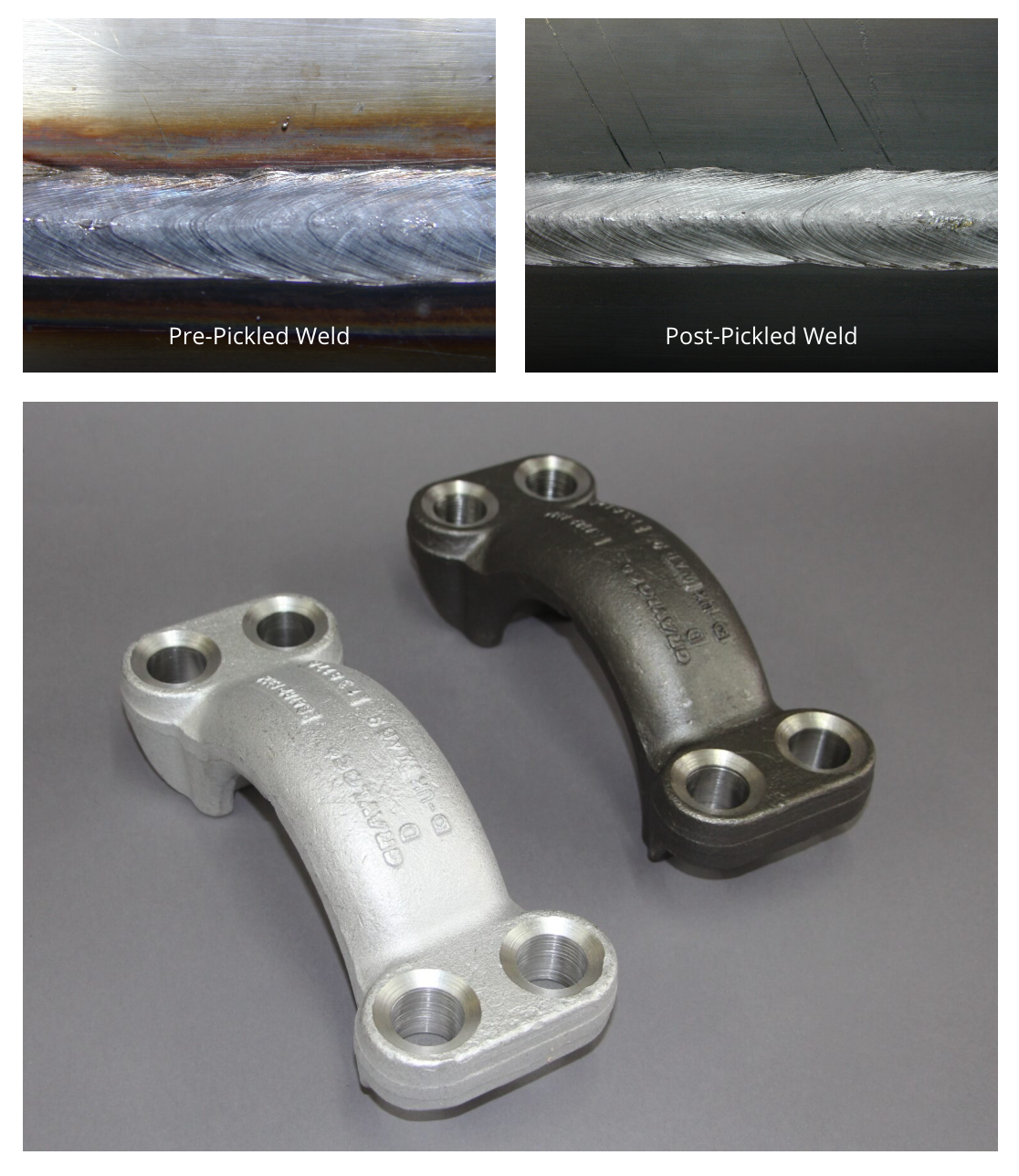
Unlike mechanical polishing (which merely pushes metal around and can embed further contaminants), pickling uses formulated dilute acid solutions to initiate a controlled chemical micro-etching process. It dissolves the damaged, heat-affected outer layer of the steel, exposing a metallurgically clean surface underneath.
The Primary Goal of Pickling:To strip away the trauma of the forge and factory floor, leaving a uniform, clean, matt grey finish that is perfectly primed to regenerate its natural, chromium-rich passive shield.
What Does Pickling Remove?
Heat Tint & Weld Scale: The dark, oxidised discolouration left behind after welding.
Embedded Iron: Free iron particles deposited by tooling, grinding, or adjacent carbon steel work.
Oxide Layers: Damaged, chromium-depleted layers resulting from extreme heat.
Fabrication Residues: General shop dirt and microscopic contaminants.
2. The Chemical Action
To understand why pickling is so effective, you must look at the microscopic level. When stainless steel is heated during welding, the chromium near the surface reacts with oxygen to form a thick oxide scale.
This leaves the layer of metal immediately beneath depleted of chromium, the exact element that gives stainless steel its anti-corrosion superpower.
Anopol’s precision pickling process chemically dissolves this compromised, chromium-depleted layer.
The chemistry typically involves a carefully calibrated mixture of acids (such as nitric and hydrofluoric acid) tailored to the specific alloy grade.
Anopol’s Proprietary Advantage: We utilise advanced chemical formulations, including our Fluorinox concentrated acid systems and specialised pickling pastes (like Paste GP and Paste GS). These formulations are engineered to tackle heavy-duty austenitic steel cleaning while protecting less acid-resistant grades (like 400 series or 303 sulphur-containing grades) from excessive acid attack.
3. Treatment Methods: How Pickling is Applied
Because components range from tiny surgical instruments to massive chemical storage vessels, pickling must be highly adaptable. Anopol utilises three primary treatment methods depending on component size, geometry, and required treatment area:
Immersion (Tank Pickling): The component is fully submerged in a bath of formulated dilute acid. This is the most effective method for ensuring uniform treatment across complex geometries, internal pipework, and large batches.
Spray-On Systems: Used for large-scale fabrications or vessels that cannot be easily submerged. Acidic gels or sprays are applied directly to the surface and later rinsed off.
Localised Paste Application: For specific, highly localised areas (like weld seams). Anopol's transparent pickling gels are brushed onto the weld to rapidly remove burn and tint without treating the entire component.
4. Pickling vs. Passivation vs. Electropolishing
A common area of confusion in surface engineering is knowing which process to specify. While all three improve surface quality, they serve distinct, sequential purposes.
(Note: Pickling and Passivation are highly complementary. Pickling strips the metal bare; Passivation ensures the new protective oxide layer builds up quickly and uniformly).
| Process | Primary Function | The Result | Ideal Application |
|---|---|---|---|
| Pickling | Removes heavy scale, heat tint, and damaged oxide layers from thermal processing/welding. | A clean, uniform matt grey surface. | Post-welding, heavy fabrication, preparation for passivation. |
| Passivation | Removes free iron and accelerates the formation of the natural chromium-oxide passive layer. | A chemically clean surface with optimised, long-term corrosion resistance. | Oxygen-starved environments, post-pickling, marine/coastal use. |
| Electropolishing | An electrochemical process that dissolves microscopic peaks and burrs to reduce micro-roughness. | An ultra-smooth, bright, highly reflective, and sterile surface. | Pharmaceuticals, food & beverage, medical devices, biotechnology. |
5. Why the Industry Trusts Anopol
With over 50 years of collective technical experience, Anopol doesn't just process metal; we engineer peace of mind. Operating from specialised facilities in Birmingham and Hampshire, we are the only partner you need for end-to-end surface treatment.
Here is why Anopol is the undisputed market leader in the UK and Europe:
Unmatched ESG and Sustainability Leadership
Surface finishing historically carried a heavy environmental footprint, but Anopol has fundamentally changed the equation. We are ISO 14001 accredited and utilise measurably cleaner chemistry.
Crucially, our cutting-edge processes are PFAS-Free (zero "forever chemicals"), allowing your supply chain to meet the highest environmental standards without sacrificing component performance.
A Complete, 360-Degree Solution
We are not merely a subcontractor. Anopol offers a trifecta of services tailored to your exact operational needs:
Subcontract Processing: Send your components to our state-of-the-art facilities for expert treatment.
Chemical Supply: We manufacture and supply proprietary, industry-leading pickling acids, pastes, and electrolytes for your in-house use.
Plant & Equipment Design: We design, build, install, and commission bespoke surface treatment plants directly in your facility.
Certified British Excellence
We hold ISO 9001 quality management accreditation and are a signatory to the Nuclear Charter. We are the trusted, strategic ally for global leaders who demand zero margins for error, including major names in aerospace, medical engineering, and food and beverage manufacturing.
Start the Finish with Anopol
When it comes to surface finishing, specifying the wrong process risks corrosion failure, rejected audits, and catastrophic rework. Getting it right ensures your components perform exactly as intended, in the harshest environments, for decades.
Whether you need subcontract processing, chemical products, or a custom-built facility, trust the experts who have defined the standards of British surface engineering for over half a century.
Contact Anopol for support with your next project.